Overview
A strong online marketing strategy is not a single tactic—it is a connected system that guides a prospect from discovering your brand all the way through purchase, retention, and referral. The real competitive advantage comes from treating every stage as a measurable revenue milestone rather than an isolated campaign.
For hosting resellers, agencies, affiliates, and marketing professionals, the challenge is rarely a lack of channels. It is the absence of a clear operational framework that ties spend, content, and conversion actions into one predictable pipeline. This article provides that framework: a full-funnel architecture with budget guidance, measurement checkpoints, and decision tools that turn scattered efforts into repeatable revenue.
Why Most Online Marketing Strategies Stall Before They Scale
Most strategies stall because they optimize for a single metric—usually traffic or leads—without connecting that metric to downstream revenue. A campaign that generates thousands of clicks but no qualified pipeline is not a strategy; it is an expense.
The root cause is usually one of three gaps:
- Funnel blindness: teams measure top-of-funnel activity but ignore what happens after the click.
- Channel silos: paid, organic, email, and content teams optimize independently, creating contradictory messaging or redundant spend.
- Infrastructure friction: slow landing pages, unreliable checkout flows, or mislocated servers quietly kill conversion rates before the creative even gets a fair test.
Closing these three gaps is the foundation of any online marketing strategy that actually produces revenue rather than vanity metrics.
Full-Funnel Architecture: Five Stages That Connect Traffic to Revenue
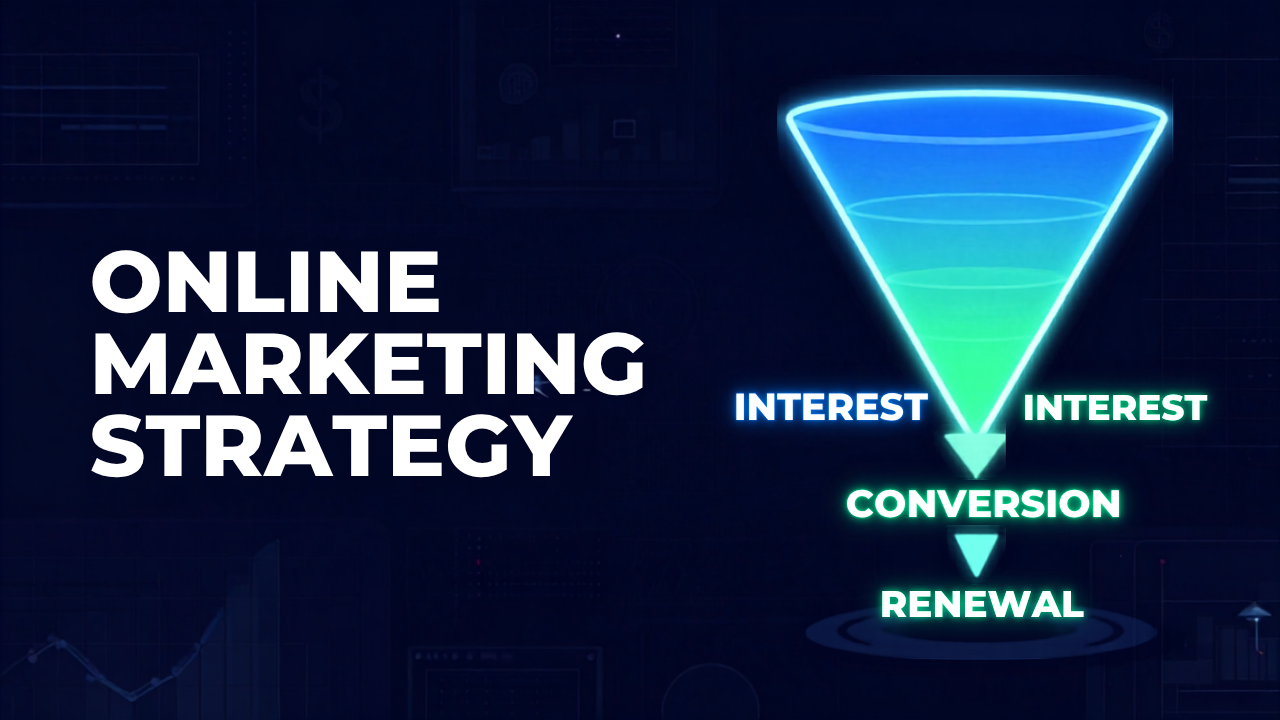
The most reliable way to structure an online marketing strategy is around five funnel stages, each with a distinct intent level, conversion action, and measurement focus.
| Funnel Stage | Audience Intent | Primary Conversion Action | Key Metric | Typical Channel |
|---|---|---|---|---|
| Awareness | Discovering a problem or opportunity | Page view, content consumption | Reach, impressions, CTR | Social, display, content |
| Interest | Exploring solutions actively | Lead magnet download, newsletter signup | Opt-in rate, cost per lead | SEO, content, paid search |
| Evaluation | Comparing specific providers | Demo request, pricing page visit, trial signup | MQL rate, lead-to-opportunity ratio | Email, retargeting, case studies |
| Purchase | Ready to buy | Checkout completion, contract signed | Conversion rate, cost per acquisition | Landing pages, sales outreach, checkout |
| Retention | Existing customer renewing or expanding | Renewal, upsell, referral | LTV, churn rate, expansion revenue | Email, support, product experience |
When every campaign is mapped to one of these stages, budget allocation becomes a logic exercise rather than a guessing game. You stop asking "how much should we spend on ads?" and start asking "which funnel stage is our bottleneck right now?"
Budget Allocation: The Stage-Based Revenue Model
A practical online marketing strategy allocates budget based on where the biggest revenue leak exists, not based on which channel feels most familiar.
The 70-20-10 allocation framework
For hosting resellers and agencies in growth mode, a tested starting allocation is:
- 70% on proven conversion channels — channels already producing measurable leads or sales at an acceptable cost per acquisition. This might be search ads targeting high-intent keywords, email campaigns to warm lists, or SEO content driving organic signups.
- 20% on pipeline-building activities — content marketing, social media presence, webinar programs, or partner outreach that feeds future pipeline but does not convert immediately.
- 10% on experimental bets — new channels, new creative formats, or new audience segments that have not yet proven their economics.
This ratio should shift as evidence accumulates. If the experimental bucket consistently outperforms, it graduates to the 70%. If a core channel's cost per acquisition climbs past acceptable thresholds, it gets audited before more budget flows in.
How hosting margin shapes marketing spend
One factor that hosting-focused businesses often overlook is how product margin dictates how much you can profitably spend on acquisition. If a hosting plan generates $200 in first-year margin, spending $80 on acquisition leaves room for profit. If the plan generates $30 margin, a $40 cost per acquisition destroys the deal.
This is why the strategy must account for customer lifetime value, not just first-sale revenue. A reseller who bundles design, migration, and ongoing support into a hosting package can justify a higher acquisition cost because the relationship produces multiple revenue streams over time.
Measurement at Every Stage: The Revenue Checkpoint System
The difference between a strategy and a wish list is measurement. Here is how to set checkpoints at each funnel stage so you can diagnose problems before they become budget drains.
Awareness checkpoint
- Are impressions and reach growing week over week?
- Is click-through rate stable or improving (indicating creative-message fit)?
- What is the cost per thousand impressions relative to your benchmark?
Interest checkpoint
- What percentage of visitors take the next step (opt-in, download, subscribe)?
- Which traffic sources produce the highest opt-in rates?
- Are there content gaps causing high bounce rates on key pages?
Evaluation checkpoint
- What percentage of leads become marketing-qualified leads (MQLs)?
- Which lead sources produce the highest close rates downstream?
- Are nurture sequences moving leads from interest to evaluation within a reasonable window?
Purchase checkpoint
- What is the conversion rate from opportunity to closed deal?
- Where in the checkout or sales process do prospects drop off?
- Does page load speed or site reliability correlate with checkout abandonment?
Retention checkpoint
- What is the 12-month renewal rate by acquisition source?
- Which customers upgrade or add services within the first year?
- What percentage of revenue comes from existing customers versus new acquisition?
These checkpoints turn a vague "our marketing is working" sentiment into a concrete diagnostic tool. When a funnel stage underperforms, you know exactly where to invest next.
Channel Coordination: Making Every Touchpoint Reinforce the Same Message
Channel misalignment is one of the most common revenue leaks in online marketing strategy. When paid ads promise one thing, the landing page says another, and the follow-up email introduces a third message, prospects experience confusion—and confusion kills conversion.
The single-message rule
Every campaign, regardless of channel, should deliver one coherent message through three touchpoints:
- The ad or content piece that creates the first impression
- The landing page that fulfills the promise and guides the conversion action
- The follow-up sequence that continues the same narrative and moves the prospect to the next stage
If these three touchpoints tell different stories, the strategy breaks down no matter how much traffic you drive.
Multi-channel sequencing
Effective hosting resellers and agencies do not rely on a single channel. They sequence channels so that each one reinforces the previous touchpoint.
A practical sequence might look like this:
- Week 1: SEO blog post introduces a concept (awareness → interest)
- Week 2: Retargeting ad offers a relevant lead magnet (interest → evaluation)
- Week 3: Email nurture delivers case study and pricing overview (evaluation → purchase intent)
- Week 4: Direct outreach or limited-time offer closes the deal (purchase)
This sequencing keeps the brand visible without overwhelming the prospect, and it allows you to measure which transitions produce the highest drop-off so you can optimize the weakest link.
How Hosting Infrastructure Supports Every Funnel Stage
Infrastructure is not a backend concern separate from marketing. It directly shapes every stage of the funnel.
- Awareness: Slow-loading blog posts or content pages increase bounce rates and waste the traffic you worked to attract.
- Interest: A lead magnet download page that times out or loads slowly loses prospects who were already motivated enough to act.
- Evaluation: Comparison pages, demo booking tools, and pricing calculators must respond quickly to keep evaluation momentum.
- Purchase: Checkout speed and reliability directly affect conversion rate—every second of load delay reduces the probability of completion.
- Retention: Uptime, performance, and support responsiveness determine whether customers renew, upgrade, or churn.
For campaigns targeting specific geographies, server location matters. A hosting reseller running campaigns for North American small businesses benefits from infrastructure positioned close to that audience. A campaign targeting Southeast Asian agencies performs better with regional deployment. The latency difference may seem small in milliseconds, but it compounds across thousands of sessions into measurable conversion impact.
This is where providers like RAKsmart become strategically relevant—not as a generic hosting choice, but as an infrastructure decision that aligns with the campaign's target geography and performance requirements. When the hosting layer matches the audience location and traffic pattern, every dollar spent on marketing works harder because fewer visitors are lost to technical friction.
Decision Framework: The Marketing Strategy Readiness Checklist
Use this checklist to evaluate whether your online marketing strategy is built for revenue, not just activity.
Audience and positioning
- Target audience is defined by role, pain point, and buying behavior—not just demographics
- Primary conversion action is a single, clear step appropriate to the funnel stage
- Value proposition communicates a specific outcome, not a generic feature list
Budget and channel
- Spend is allocated based on funnel-stage bottlenecks, not channel habit
- At least 70% of budget goes to channels with proven conversion evidence
- Channel selection aligns with audience intent at each funnel stage
Measurement and optimization
- Every funnel stage has a defined metric and a review cadence
- Cost per acquisition is tracked against customer lifetime value
- A monthly review process exists to shift budget toward top performers
Infrastructure and experience
- Landing pages load in under three seconds for target geographies
- Checkout or signup flow is tested on mobile and desktop regularly
- Server location and network quality match the campaign's primary audience
Coordination and consistency
- Ad message, landing page, and follow-up sequence tell the same story
- Multi-channel sequences are planned rather than improvised
- Brand voice and offer framing are consistent across all touchpoints
If more than two items on this checklist are unchecked, the strategy likely has a revenue leak that will limit ROI regardless of how much traffic you generate.
Common Strategy Mistakes That Drain Revenue
Even well-intentioned strategies fail when certain patterns repeat:
- Optimizing for cost per lead instead of lead quality. A cheap lead that never converts is more expensive than an expensive lead that closes.
- Launching on too many channels at once. Without baseline data from one channel, spreading across five makes optimization impossible.
- Ignoring the retention stage. Acquiring a new customer costs five to seven times more than retaining an existing one; a strategy that stops at the first sale leaves significant revenue on the table.
- Treating content as one-time production. Evergreen content needs periodic updates to maintain search rankings and relevance.
- Skipping the infrastructure conversation. Marketing teams that never discuss hosting performance with their technical counterparts will always be puzzled by mysterious conversion drops.
FAQ
What is the most important part of an online marketing strategy?
The most important part is aligning every element—audience definition, offer, channel, and conversion action—to a single measurable outcome at each funnel stage. A strategy that tries to accomplish everything at once accomplishes nothing well. Start by identifying the biggest bottleneck in your current funnel and building the strategy around closing that gap first.
How much should a hosting reseller spend on marketing per month?
There is no universal number, but the stage-based framework provides guidance. Allocate roughly 70% of your marketing budget to channels already producing measurable conversions, 20% to pipeline-building activities like content and partnerships, and 10% to testing new approaches. The total amount should be sized so that your cost per acquisition stays well below the customer lifetime value of your typical hosting plan.
Which channels work best for hosting-related marketing campaigns?
Search (both organic and paid) tends to produce the highest-intent traffic for hosting offers because prospects are actively looking for solutions. Email marketing is the strongest channel for nurturing and retention. Content marketing and SEO build long-term authority. Social channels work best for awareness and community building rather than direct conversion. The best approach is a coordinated mix rather than reliance on any single channel.
How do I measure whether my online marketing strategy is working?
Set a checkpoint metric for each funnel stage. At the awareness level, track reach and click-through rate. At the interest level, measure opt-in or lead capture rate. At evaluation, track MQL rates and lead-to-opportunity conversion. At purchase, measure cost per acquisition and conversion rate. At retention, monitor renewal rates and customer lifetime value. Review these metrics monthly and shift budget toward the stages and channels showing the strongest performance.
How does hosting infrastructure affect marketing campaign performance?
Hosting infrastructure directly impacts page load speed, uptime, and the reliability of checkout or signup flows—all of which influence conversion rates. If your landing pages load slowly or your site experiences downtime during a campaign, the money spent driving traffic to those pages is partially wasted. For campaigns targeting specific regions, choosing servers located near your audience reduces latency and improves the user experience, which can meaningfully improve conversion rates over time.
Conclusion
A profitable online marketing strategy is not about being everywhere or spending more—it is about building a connected funnel where every stage has a clear purpose, a defined measurement, and a direct path to revenue. When audience targeting, offer positioning, channel selection, and infrastructure are aligned, conversion rates improve not because of a single tactic but because the entire system removes friction at every step.
If you are ready to build a strategy that ties marketing activity directly to measurable revenue, start by auditing your current funnel against the readiness checklist above. Then explore hosting and infrastructure options that match your campaign geography and performance requirements. RAKsmart offers a range of plans—including VPS, dedicated servers, and cloud hosting across multiple global locations—that can serve as the technical foundation for campaigns targeting audiences in North America, Asia, and beyond.